Showing posts with label Those Places Thursday. Show all posts

Thursday, July 27, 2017

Those Places Thursday - The Little Schoolhouse

Those Places Thursday
The Little Schoolhouse


While this doesn't show the building's full view, I wanted to share this one with you.

This is now a community center in the little town of Waiteville, in Monroe County, West Virginia. It served as a school house for the community for many years. 

Inside, there is a central hall, with a back door directly behind the front at the end of that central hall.

To the right is a large classroom, that at one time had a folding wall that could separate it into two classrooms, but when opened could be used for assemblies. Behind that room are two restrooms, a janitor closet, and steps that lead down into a basement, where years ago the school cooks made lunch for the children. Today, the kitchen is located on the main floor, directly across the hall from the restrooms. And as you enter from the front, on the left are two large classrooms.

This is the school where my Dad attended. Photographs of him are in the hall as one of the schools attendees. There aren't many photographs, as the community was, and remains, quite small, and rural. Dad left school after the 8th grade, went into the Navy and and earned his GED. But the school taught children from 1st grade through 12th for many years.

I have a first cousin who attended school here through junior high, and then went across the mountain to Gap Mills for high school..

I have another first cousin, who attended school here in the lower grades before the school house finally closed its doors.

About 20-years ago, the community purchased the building and lovingly restored it as a community center. Since our family is originally from this area, we rented the building for our family reunions, which are held every two years.

So, the building holds a place dear in our hearts, as I'm sure it does to all who attended school there.

Is there a building in your the community, thought of as your family's community, that holds fond memories? Please feel free to share with us here! We'd love to hear from you!

Thursday, July 20, 2017

Those Places Thursday - Don't Overlook State Parks!

So, you're probably wondering how a State Park can figure into finding out more about your ancestry. Am I right?

Well, I found out a lot about what happened to two of my ancestors, on a particular date, by walking through a State Park!

To be exact, Droop Mountain Battlefield State Park, located at Droop Mountain, in Pocahontas County, West Virginia.

This is the tower overlook at the top of the mountain.
From here, you can look down the steep slope where the climb can easily be seen.

Let's allow Wikipedia to give us more on the battle:

"The Battle of Droop Mountain was a battle in Pocahontas County, West Virginia, that occurred November 6, 1863, during the American Civil WarConfederate forces engaged, but failed to prevent Union forces under Brigadier General W.W. Averell from a rendezvous with other Federal troops in a joint raid on Confederate railways. Droop Mountain was one of the largest engagements in West Virginia during the war. As a result of the Union victory, Confederate resistance in the state essentially collapsed.

Background

Assigned command of one of two brigades involved in the planned raid on the railroads, Averell moved toward southwestern Virginia with the purpose of disputing movement on the Virginia & Tennessee Railroad. The second column, under Brigadier General Alfred N. Duffié, destroyed enemy military property en route, while Averell probed for Confederate defenders.

Battle

Map of Droop Mountain Battlefield core and study areas by the American Battlefield Protection Program.
On November 5, 1863, Averell attacked Confederates at Mill Point in Pocahontas County, driving the Southerners from their position back to the summit of Droop Mountain, where they were reinforced by a force under Brig. Gen. John Echolsconsisting of Patton's Brigade and one regiment from Albert G. Jenkins's command. The Confederate position was a relatively strong one, reinforced by breastworks commanding the road.
The following day, Averell elected to attack. Throughout the morning, Echols' smaller Confederate force held the high ground and blocked the highway with artillery. However, in the early afternoon, Averell turned Echols' left with his infantry, and then sent dismounted cavalry in a frontal assault on the main Confederate lines. After a brief yet violent battle, many Confederates fled, throwing away their arms and scattering for safety. Averell's cavalry pursued until dark, capturing several prisoners and a large quantity of arms, ammunition, and materiel. Echols rallied much of his force, but was forced to retreat into Virginia.

Aftermath

Averell's victorious force rejoined Duffié's brigade at Lewisburg on November 7. The reunited Union columns, burdened with prisoners and captured livestock, were in no condition to continue their raid, but they had effectively ended Confederate resistance in West Virginia.
The battlefield site is preserved and administered by West Virginia as a state park.
The unknown Confederate dead are buried in the Confederate Cemetery at Lewisburg, listed on the National Register of Historic Places in 1987."

As you walk the battlefields, you are in awe that you are walking where so many men died.

There are two Memorial markers on the field:


JOHN D. BAXTER
THIS MARKS THE SPOT
WHERE JOHN D. BAXTER,
ORDERLY SERGEANT, CO. F
10TH W.VA. INFT. FELL INSIDE
THE CONFEDERATE LINE
LEADING THE LAST CHARGE
NOVEMBER 6TH, 1863.


IEUT. HENRY BENDER
COMMANDED CO. F IN THE LAST CHARGE
THAT THE 10TH W.VA VOL. INFT. MADE
THAT BROKE THE CONFEDERATE LINE
AT THE BLOODY ANGLE WHERE
SO MANY OF THE BRAVE MEN
OF BOTH ARMIES FELL
NOVEMBER 6TH, 1863.

For me, at least, there is a reverence there, in that place, much as there is when you visit the Alamo, in San Antonio, Texas. So many died there that day. And the feelings of bravery, and death, still haunt those places.

A lone cannon, of the era, marks the edges of the battlefield.

A tiny museum sits next to the battlefield. A log cabin that was added after the Civil War.


It's three room interior is filled with memento's of the Civil War, and the bloody battle of Droop Mountain.


Getting to actually walk the grounds, and see the relics, the battle of Droop Mountain became very real for me. And I feel particularly blessed to have been there to see it through the eyes as a descendant of two survivors of the battle.

Pvt. Henry (Gottleib) Dreher, who served in the Union's 47th Ohio Infantry, which fought that bloody day.

And Pvt. William Bean, who served in the 14th Va. Infantry.

Two men. Fighting on opposite sides. Dreher, my gr-gr-grandfather. Bean, my gr-grandfather. Either of the men could have been killed! And if either had been, I would not be the one sitting here this afternoon, in my nice, air-conditioned home, writing this post. But for the grace of God....

Do you have ancestors who fought during the Civil War? If so, do you know any of the battles they might have fought in? And if so, do you know if any of your ancestors fought against other of you ancestors in the same battle?

Let us hear from you below. 

Don't forget to check out museums, battlefields, and yes, even State Parks, for places of interest in your ancestors!

And if you are interested in visiting Droop Mountain Battlefield State Park, it is located directly on US 219 between Hillsboro, WV (where the author/missionary Pearl S. Buck was born) and Mill Point, WV. Pack a picnic lunch, because you will want to take your time walking over the site, and going through the museum. There are several picnic areas, which are very nice, and hiking trails to make your outing complete.


Thursday, July 6, 2017

Those Places Thursday - Scenes of Home

Tiger Lillies are in bloom, and several people have had them in their homes. Love the scent!


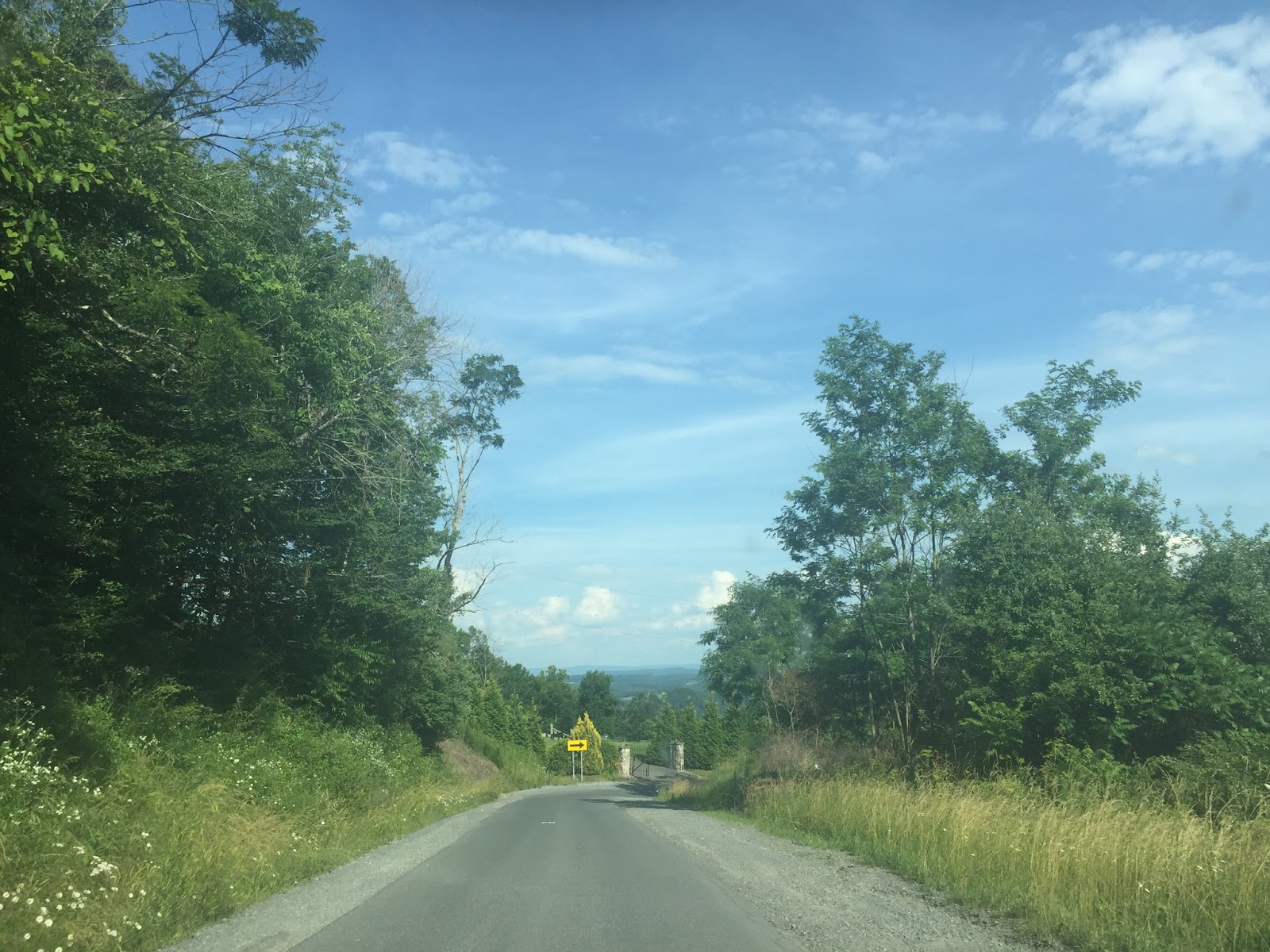
I travel down some dirt roads and lanes to get to some of my clients.
(You will recall that from yesterday's post!)
Most are quite beautiful, as this one. Serene fields on either side. Flowering bushes and berries growing along the fence lines.


Hay cutting is going on locally. One of my clients had spent the morning baling these big, round bales of hay for his daughter's cows. Nothing is lovelier to a farmer than a field of hay to feed the livestock!
Of course, nothing can be worse on the allergies either!


I go by some very large estates. Here, if you look closely, you see the gates are open to this one. But look, there, ust beyond the gates, at the horizon. Have you ever seen anything more lovely than the mountains in the distance?
And from here, I am sitting on top of a mountain!


For you country western fans, take a look at this photo. This was taken just south of downtown Oak Hill, West Virginia. See the large green road sign?  Now take a look at the smaller one below it.

Hank William, Sr. Memorial Road
It was here the immortal singer died, on January 1, 1953.


It's the little things that make this home so special to me. Being a country girl makes it "almost heaven"!


Friday, June 16, 2017

Family Recipe Friday - Granny's Strawberry Poke Cake

Granny's Strawberry Poke Cake

Okay folks, here is the recipe that I have been promising to put up for some time now. It has been requested several times, because of it's versatility.

When my grandmother, "Granny", made dessert, this is the cake she usually made (this or her candied orange cake). This was by far her most popular. And everyone makes it out to be a big deal, when in reality, it's probably one of the easiest there is! And EVERYONE loves it!

You simply need a white cake mix, a large (makes 4 cups) box of jello mix in the flavor you want to make the cake (in this instance strawberry), a tub of Cool Whip, and a carton of strawberries (you can slice them, or leave them whole).

Bake the cake according to directions, and allow it to cool in the pan. Next empty the jello mix into a medium bowl, and add 2 cups of boiling water. Stir until well dissolved. Next, take the handle of a wooden cooking spoon, and poke holes all over the top of the cake, about 3/4 of the way deep into the cake. Now pour the jello mixture all over the top of the cake. It will fill up the holes you have made. Place the cake pan in the refrigerator and allow the jello to set up. Once it is cold, and the jello firm, you are to ice the cake with the Cool Whip. Use as much or as little as you like (I usually make the cake in a 13"x9" cake pan, and use a large tub of Cool Whip.) Then decorate the top with the strawberries. You can also add red candy sprinkles if you like.

To make it another flavor, try using orange jello instead, and top with mandarin orange slices, or candied orange slices.

You can use lime jello, and top with candied lime peels! Use lemon jello and top with candied lemon peels! Use peach jello and top with canned peach slices! If there is a flavor of jello, you can change the flavor of this cake! Just add whatever fruit matches the jello to the top of the Cool Whip after chilling! And everyone loves this!

Enjoy!


<<>><<>><<>><<>><<>><<>><<>><<>><<>><<>><<>><<>><<>><<>><<>><<>><<>><<>>

Did you guess the Those Places site from yesterday's post?

If you were in Germany prior to the Regan Administration, you would have seen this familiar site in (drum roll please), Berlin, Germany. You were actually looking at the Berlin Wall, which, of course, is no longer standing.

Did you guess correctly? Let us know how you did!

Thursday, June 8, 2017

Those Places Thursday - The Banet Farm

This is the old Banet Farm, located on Floyd's Knobs, Indiana.

This is the home my Great Great Great Grandparents, set about raising their children. They were Etienne Banet and Francois Bidaine Banet.

The couple had 12 children. Seven of these children were born in France, prior to the immigration to America. The last 5 were born in Indiana, and were much younger than the older 7. The couple had a son Isadore (born in France) who married Rosalie Sprigler.

Irene(my grandmother) was the 7th of 8 children born to Francis Isidore Banet (Isidore and Rosalie's son) and his wife, Adeline Josephine Eve.

Adeline was the daughter of Joseph Eve, and Annette DuBois. She was the youngest of 6 children. Her mother, Annette, died giving birth to her, in 1867. Adeline's Aunt Adaline DuBois, Annette's younger sister came to care for her sister's children. In 1871, when Adaline DuBois finally turned 21, Joseph married Adaline. She had already been in the home taking care of her sister's children since the time of her sister's death. Adaline DuBoise Eve, and Joseph, went on to have another 7 children, which gave Joseph a total of 13 children.

From Joseph and Annette DuBois were these 6 children:
Nicholas (b.1858)
Joseph (b. Jan 1870)
Lawrence (b. 1860)
Alfred (b. 1863)
Charles (b. 1865)
Adeline Josephine (11 Feb. 1867-05 Nov. 1958)

From Joseph and Adeline DuBois were these 7 children:
Louise (1877-1968)
Mary (b. Jul. 1878)
James (b. Apr. 1882)
Hattie (b. Dec. 1883)
John Edward (b. Aug. 1886)
Gilbert (22 Jun 1888-Apr 1969)
Flora (b. Mar. 1890)

Adeline died at the age of 91. My grandmother told me she had coal black hair when she died, and had never dyed a hair on her head. (I don't take after that part of my ancestors! I've got snow white hair, at 57, and this matches up with my Dad's family, the Bean's.)

Irene, Adeline's daughter, and my Grandmother, had very few gray hairs when she died at the age of 83. Irene's daughter, my mother, Lois (1938-2015) also had more dark hair than gray when she passed at the age of 77. (Actually 2 days before her 77th birthday.)

Grandmother told me about growing up with her family in the Banet home. It was a fairly relaxed family for the times. Both sides of her family, the Eve's and the Banet's had immigrated from France (the Alsace region), and knew one another in France.

Sadly, the elder Banet's, my great-great-great-grandparent's, left France and came to the United States. They, of course, brought their children with them. However, after a few years, they traveled back to France, to settle property claims and get their finances settled. They left the children in Indiana with family members. When they returned to Indiana, the now nearly adult children became enraged that their younger siblings  were to be given equal shares in the family property that they (the older children) had worked so hard to preserve for their. And that is how their Will was settled when the parents passed. The younger children obtaining an equal portion of the rather large property. The family split. The older children moving into town, while the younger kept the farm and property on the Knobs.

When I first began working on genealogy, and asked my Grandmother about the family split, she insisted that her family was NOT related to the Banet's on the Knobs. (Does the phrase, "Even unto the next generation..." come to mind?) Even though the matter should have died off with the parents, my Grandmother insisted to her dying day that she was of no relation to "those" Banet's. (I find it all rather amusing at best, and at worst I do empathize with the older children who had labored to preserve the land for their parents, and as an inheritance for themselves, just to have it knocked down from a small split in acreage, to a rather large split, with them feeling let down.) By the time the youngest child was born, in 1844, the eldest was already 22, and had spent his youth working very hard to make a profitable farm that he would share with his older siblings. Then along came the last 5 children, and instead of a 7 way split, they were expected to split it 12 ways. I suppose the elder didn't think the property was large enough to make it a profitable venture if split 12 ways. (I haven't been to Floyd County yet to research the property.)

Such a pretty little farm house for such a nasty, nasty split in family.

Uh, but then, am I related or not? Granny (as we called my Grandmother) would tell me of course I am not. Ahhh, but we know better, don't we!

Do you have a history of a family split in your ancestry? Life is so fleeting, it is so sad to believe family could be that way to one another. How could they have reached an amical settlement in the best way?

What would you have done? Would you have thrown it all away to just make a point? Or would you have accepted your portion, and been happy to have received whatever it was?

A little something to ponder on.

Thursday, June 1, 2017

Those Places Thursday

Can you tell me where this dam is located?

I'll give you a few hints:

1) This is located in West Virginia.

2) The Greenbrier River empties into this river.

3) The dam is located in a railway town.

4) Highways 3 and 20 converge here.

5) A large State Park is nearby.

Okay, folks, that's it. See if you can find the name of this dam, and the river it crosses!
Be sure to check back tomorrow for the answer!

Thursday, May 25, 2017

Those Places Thursday

I have so loved sharing those places with all of you! Thomas McEntee came up with the correct answer last Thursday! Yeah Thomas! Sorry, no prize, but maybe we can start doing that soon if enough people get involved!

Today I'm going to take you someplace else.

This photo is taken from a post card. (Yeah, don't you wish I could photograph like that? Me too! LOL)

It's what you can't see that I want you to tell me about. I know you will notice a very famous landmark in the distance. What I want you to tell me, is what famous landmark is this photograph taken from? There are clues. So, if you've been to this city, you should be able to figure out where the photographer was at when taking this pic!

Let us know where you think the photograph was taken from. Check back tomorrow for the correct answer!

Thursday, May 18, 2017

Those Places Thursday


Can anyone tell me where this statue is located?
I can tell this bronze sculpture was made in 1545 by a very well known sculptor, Benvenuto Cellini.

Take a close look at it. The statue is of a man, holding a severed head. But not just any severed head. A woman's head. Look closely at what looks to be curly hair. Only this is not curly hair, but instead it is writhing snakes!

If you will recall your Greek mythology (what do you mean you didn't study Greek mythology?), you will recall the name of the woman with snakes instead of hair. And you will recall who slew her.

This statue stands in the Piazza della Signoria.

Oh, I do believe you may be getting warmer!

If you know the name of the two characters, and/or the location (city, country) of this statue, please be sure and leave it in the comments below.

If you don't know any information, please come back tomorrow to read about it!

Ciao bella!

Thursday, April 20, 2017

Those Places Thursday

If you know what this place is called, or where it is, please leave a comment. If you don't know, then check back tomorrow for the answer.

****HINT: Nickname: Underground White House.

Thursday, April 13, 2017

Those Places Thursday

Those Places Thursday

Can you identify the place shown above? It is within the United States. It is considered the oldest of this kind. And I have ancestors residing here.

Can you guess where it is?

If you think you know, please leave us a comment with your guess.

I will tell you, that I visit here at least one or two times a year. And I always leave excited about doing genealogy after every visit, even though it remains unchanged on each visit.

Be sure to come back tomorrow and see the answer of Those Places Thursday!

Thursday, April 6, 2017

Those Places Thursday


This photograph was taken from an old postcard I had purchased back in the 1960's.
The photograph was taken probably 40 years before that! And before this place was rebuilt.
There are several graves inside this building, including two of my 8x great grandparents.
Can you guess where this is located?

Be sure to come back tomorrow and see if you were correct!

Thursday, March 30, 2017

Those Places Thursday

Those Places Thursday


Okay, so we will find herself visiting another spot today. Please post below if you can tell where this place is! (Hint: It's in Europe)

Sorry, I can't take credit for this photograph. It is taken from an old postcard I have.
2nd Hint: It's named after a mythical creature!


Thursday, March 9, 2017

Those Places Thursday - Can You Guess Where I Am?

This is a place I once visited. Can you guess where it is?
This is a sculpture of "The Bathing Lady" in the middle of a lake.
Can you guess where?


****Did you guess yesterday's photo of my 5th Cousin 4X removed?
The answer is none other than the abolitionist, John Brown, who was hanged at Charles Town, (West) Virginia on December 2, 1859. He led the massacre at Pottawatomie, and the raid on Harper's Ferry. He was the father of 20 children, 11 of whom lived to become adults. Our common ancestor is William BATEMAN (1590-1658).

Thursday, March 2, 2017

Those Places Thursday


Do you recognize this place?

You probably know more about it than you think you do. Just from looking at it, one might think it a lovely castle, with a curiosity fence surrounding it so that well meaning visitors don't come too close.

This is the Tower of London in England.

During the reign of Henry VIII, this particular building, or rather it's grounds, saw many bloody beheadings. And it was only recently that I learned of ancestors who were sent here at old Henry's request!

Lord Thomas Howard, my 10th great grand uncle, son of Sir Thomas Howard, 2nd Duke of Norfolk (my 10th great-grandfather), was imprisoned here in early July 1536. He had secretly become engaged to Lady Margaret, the King's sister, and his successor to the throne after his two daughters. The king became enraged over the secret engagement. Both Sir Thomas Howard and Lady Margaret Tudor were thrown into the Tower of London. On 18 July 1536 an Act of Attainder accusing Lord Howard of attempting to 'interrupt ympedyte and lett the seid Succession of the Crowne' was passed in both houses of Parliament. The Act sentenced Howard to death, and forbade the marriage of any member of the King's family without his permission.

While in the Tower, Lady Margaret came down with a fever. She was moved to Sion Abbey, where she was allowed to recuperate. Howard, however, remained in the Tower. His death sentence was reduced to life imprisonment in the Tower.

On 31 October 1537, Howard died from a "fatal illness", while still in the Tower. His corpse was turned over to his mother (my 10th great grandmother), the Dowager Duchess of Norfolk. She was given strict instructions to bury him most swiftly and "without pomp". (Funerals for the elite were large lavish affairs, and often cost several thousand pounds back then, equivalent to over a million dollars today.) His mother then buried him immediately at Thetford Abbey.

This is all that remains of Thetford Abbey (or Thetford Priory) today. It is here that Sir Thomas Howard lies buried. If there are graves remaining here, there are no stones to mark their place.

Sir Thomas was but one of a few of my ancestors who was held in the Tower. And we'll talk later about beheadings of a few of those! (Oh Henry...you were such a naughty boy!)